
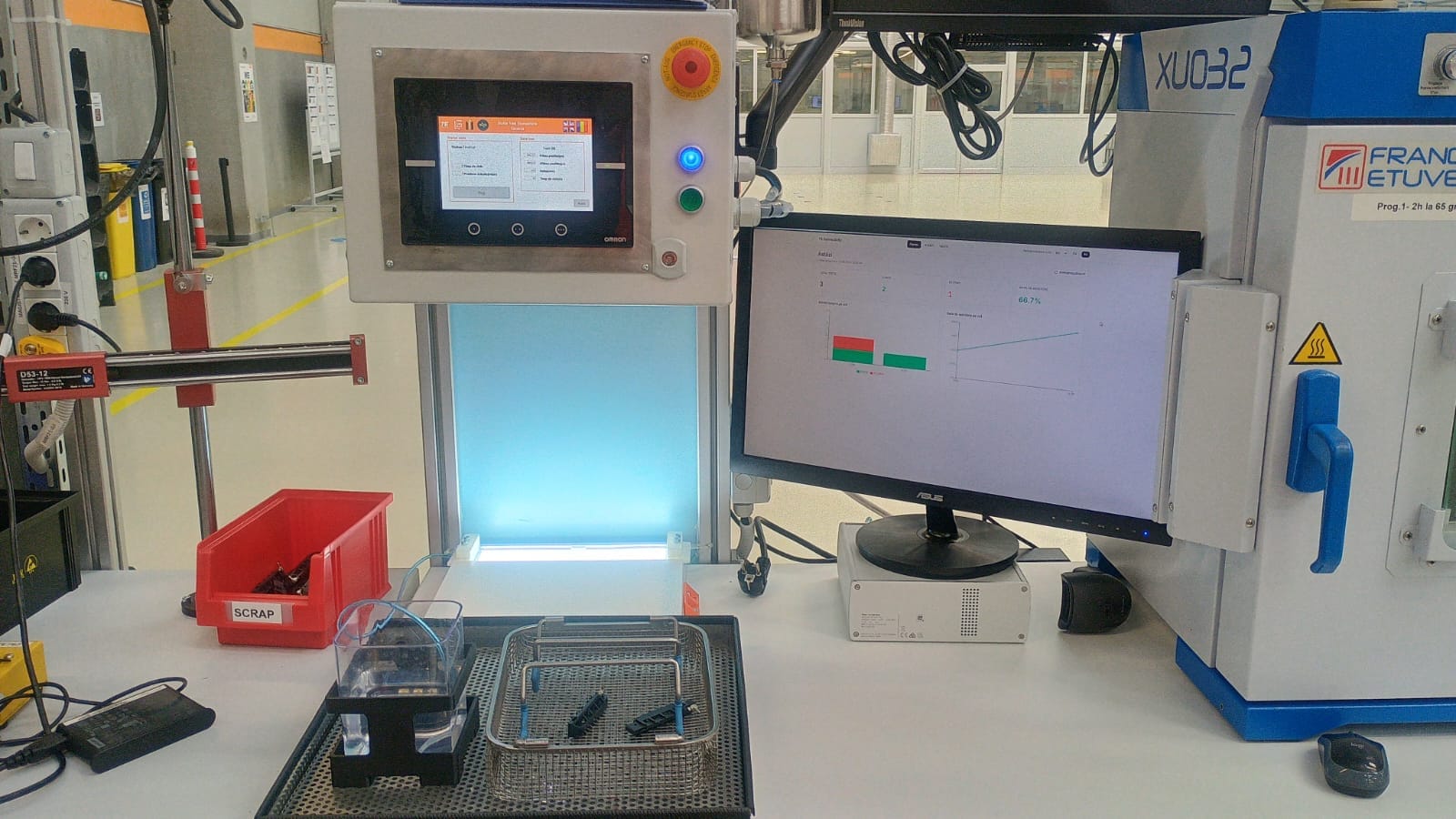
A station that “reads” an air bubble to detect leaks on the order of 10⁻³ mbar·L/s.
In leak testing, the problem rarely lies in the big leaks. Those are easy to see. The real challenge is micro-leaks: small enough that you cannot feel them, yet large enough to compromise a component in service. This station was built precisely for that difficult zone, to turn a minuscule loss into a clear, repeatable and traceable verdict, directly on the production line.
The challenge
The client needed a reliable method of verifying the leak-tightness of a component, with a set of requirements that do not sit easily together: high sensitivity to very fine leaks, a simple OK/NOK verdict that any operator can grasp instantly, and full traceability of every part, all without slowing the line and without depending on subjective interpretation by the operator.
The solution: an air bubble and a camera
Instead of a classical pressure sensor, the station uses an optical method, made elegant by its simplicity. The component is connected to a reference water line that contains a single air bubble, positioned within the field of view of a machine vision camera. The system applies a controlled vacuum; if the part leaks, the exchange of air through the defect displaces the bubble. The camera tracks that movement, the system converts it into millimeters and compares it against a preset threshold.

The result is an objective, visual and precise measurement: a sub-millimeter bubble displacement corresponds to a leak rate on the order of 10⁻³ mbar·L/s (below 0.05 sccm), in the industrial “fine leak” range. The leak is no longer an abstract number, it becomes a motion you can actually see. So that every test starts from the same conditions, the station automatically returns the bubble to its reference position between cycles, ensuring that the part just tested cannot influence the next measurement.
Under the hood: an integrated industrial platform
Behind this simple idea sits an automation architecture built for reliability and easy maintenance, integrated end-to-end on the Omron Sysmac platform:
- a programmable controller (PLC) that orchestrates the cycle and makes the OK/NOK decision;
- a smart vision camera that measures the bubble position;
- a Festo pressure/vacuum generator, controlled over Modbus TCP;
- a bilingual touchscreen HMI for the operator, with production, maintenance and configuration modes;
- an industrial PC that hosts the database and the reporting interface.
All devices communicate over a single Ethernet network, which means less cabling, faster diagnostics and a station that is easier to maintain.
Traceability and control, not just a verdict
Every tested part is logged automatically: timestamp, measured value and result. On top of that database sits a web interface with three levels of detail: a “live” dashboard displayed on the line, a list of the current day’s tests, and a complete history with date filtering, pass-rate statistics, and CSV and Excel export.
In practice, from the operator at the line to the quality department, everyone sees exactly the information they need: the operator gets a clear OK/NOK, while quality gets the trends and the evidence. The test is not isolated at the end of the line, it feeds a useful data flow throughout the process.

A collaboration
The project was delivered as a collaboration between Corox Engineering and Lagrange Engineering, combining complementary competencies into a fully working, turnkey station.
What this project demonstrates
This station is an example of engineering where a simple physical idea, a bubble that moves, is turned into a precise industrial instrument through computer vision, real-time control and data software. Exactly the kind of solutions we build: not just machines that work, but systems that measure objectively, report transparently and are easy to operate and maintain.
Do you have a testing application or a line you want to automate? Let’s talk.